Turning point in higher education: Entrepreneurship among alumni shows cautious recovery after years of decline
The Hague – After a decline that began in 2017, graduates of Dutch universities and universities of applied sciences are finally choosing entrepreneurship more often again in 2025. This is shown by the new Founder Monitor, a large-scale study conducted by Unknown University of Applied Sciences in collaboration with Prof. Roy Thurik, Professor of Entrepreneurship and Economics at Montpellier Business School. The most striking conclusion: there is no difference between the entrepreneurial ambition of academic university graduates (WO) and graduates of universities of applied sciences (HBO).
For the monitor, the career paths of alumni from 30 Dutch higher education institutions (14 universities and 16 universities of applied sciences) were analysed. Using a new analytical method, more than half a million graduates were scanned for entrepreneurship-related job titles five years after graduation. The dataset covers graduation years from 1995 to 2020, with a forward-looking view of the labour market situation in 2025.
Is the dip over?
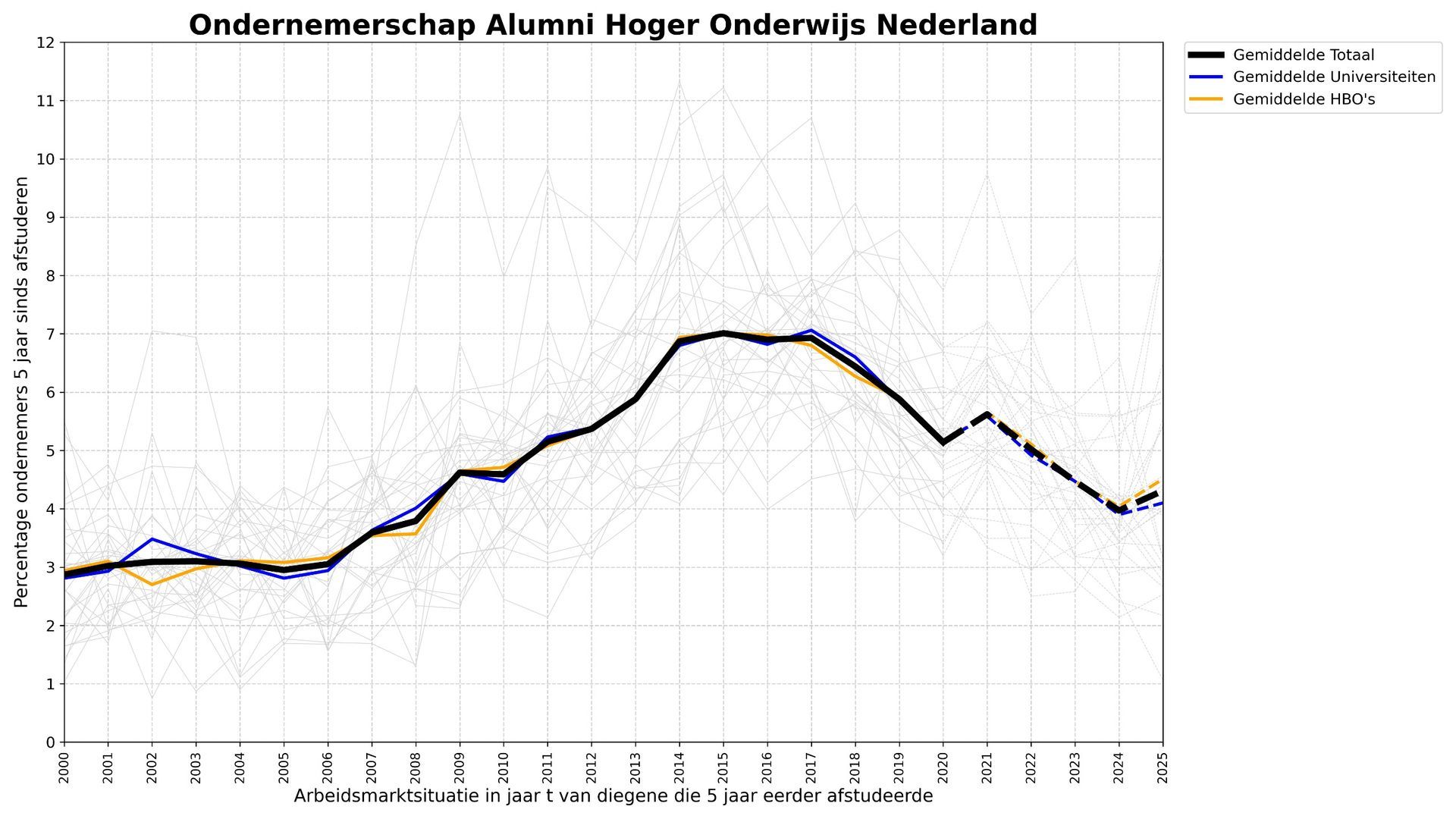
The data shows a clear wave-like pattern. Between 2005 and 2014, the percentage of entrepreneurial alumni more than doubled from 3% to 7%, partly driven by government stimulation programs introduced by the Dutch Ministry of Economic Affairs. From 2017 onwards, however, a decline began, reaching a low point around 2024 (4%).
For the first time, there now appears to be light at the end of the tunnel: the data for 2025 suggests a recovery to 4.5%.
“It is tempting to fully attribute the dip of recent years to Covid-19, but the decline started earlier,” says Roy Thurik, Professor of Entrepreneurship and Economics at Montpellier Business School. “What we are seeing now is a cautious turning point. Optimism about a future as an entrepreneur is returning among recent graduates.”
Myth debunked: applied education is not more entrepreneurial than academic
A persistent assumption is that practice-oriented HBO education produces more entrepreneurs than research universities. The Founder Monitor shows that this assumption is unfounded. The curves for HBO and academic graduates are nearly identical. This implies that macro-economic factors and the spirit of the times weigh far more heavily than the type of education someone has followed.
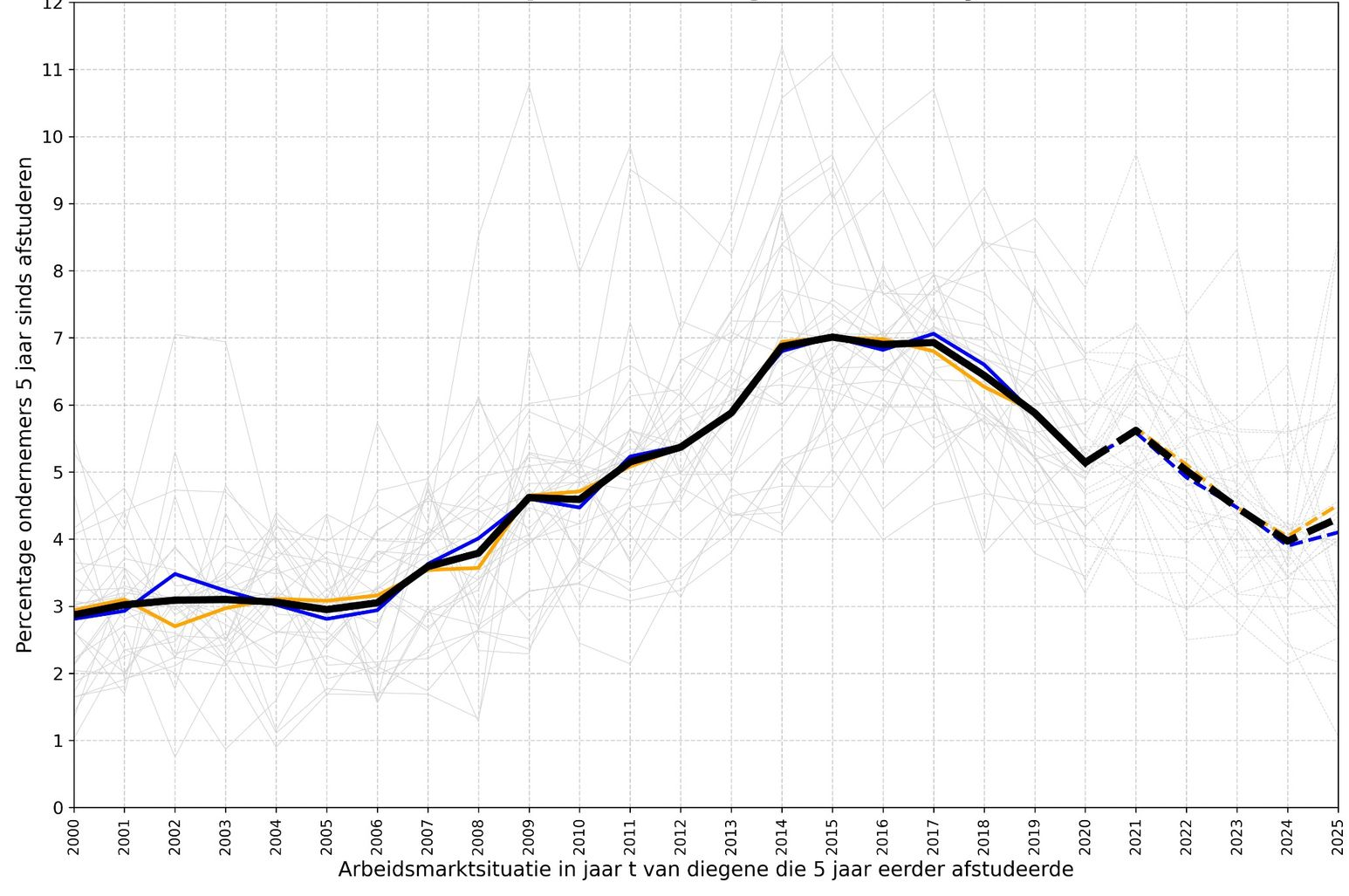
Figure 1 Percentage of entrepreneurs within five years after graduation in Dutch higher education (2000–2025), based on an analysis of approximately 500,000 alumni. The graph shows the averages for universities (blue), universities of applied sciences (orange), and the total (black) as thick lines, compared to individual institutions in grey. The dotted period (2021–2025) marks a preliminary trend, for which the dataset is still being expanded.
The dataset includes the universities Erasmus, Maastricht, Open Universiteit, Radboud, RUG, TU Delft, TU Eindhoven, Tilburg, Leiden, Twente, Utrecht, UvA, VU and Wageningen, and the universities of applied sciences Avans, Breda, Den Haag, Fontys, Hanze, Inholland, Leiden, Rotterdam, Utrecht, HvA, HAN, HZ, Saxion, Van Hall Larenstein, Windesheim and Zuyd. Due to insufficient data quality, Aeres, AHK, ArtEZ, Codarts, Design Academy, Gerrit Rietveld, KABK, HKU, NHL Stenden and the University of Humanistic Studies were excluded.
The gap with the labour force remains large
Despite the slight increase, there is no reason to become complacent. While approximately 12% of the total Dutch labour force is currently registered as an entrepreneur, higher education remains far behind at only 4.5% to 5%. It should be noted that our definition of “entrepreneur” is somewhat stricter than the definition used for the total Dutch labour force.
This gap shows that there is still significant potential for educational institutions. Effective stimulation programs prior to 2010 (such as the Centres of Entrepreneurship) demonstrate that policy can have real impact. The current numbers are a wake-up call: if the Netherlands wants to maintain its innovation capacity, entrepreneurship education must once again become a national priority.
Future of the Founder Monitor
Unknown University of Applied Sciences will further expand the Founder Monitor in the coming years. Follow-up research will focus on differences between specific fields of study (technical vs. social), international vs. Dutch students, the impact of specific incubators, and the geographic distribution of emerging talent.
For more information look at www.unknown-universityas.com/foundermonitor
About Unknown University of Applied Sciences
Unknown University of Applied Sciences is a university of applied sciences with accredited Bachelor’s and Master’s programs fully focused on entrepreneurship. Students start building their own company during their studies, where theory is directly applied in practice.
About the research
The data was collected by AlumniScan based on approximately 500,000 LinkedIn profiles. Alumni were identified five years after graduation based on job titles such as founder, oprichter, owner, zzp’er, eigenaar or venture builder.